
The mesmerizing flow of a lava lamp is a staple of earthly relaxation. Its blobs slowly rise and fall in a dance dictated by heat and gravity. But what would happen to that iconic motion in the microgravity environment of the International Space Station? Let’s take a classic model, like the X-Men Wolverine lava lamp, on a hypothetical mission to orbit and explore the fascinating physics that would completely redefine its behavior.
Table of Contents
Earthly Rules Gravity-Dependent Dance
On Earth, a lava lamp operates on a simple, elegant principle of density-driven convection:
- The bulb heats the wax at the bottom, causing it to expand and become less dense than the surrounding liquid.
- Because of gravity, this less-dense wax blob becomes buoyant and floats upward.
- At the top, away from the heat source, the wax cools, contracts, and becomes denser.
- Gravity pulls this denser blob back down to the bottom, where the cycle repeats.
This gentle, continuous cycle is the “flow” we know and love. The lamp’s design, from the wax formula to the bulb wattage, is finely tuned for this 1-gravity environment.
The Space Station Rulebook Gravity Is (Almost) Gone
In the microgravity of the ISS, the primary force—gravity—that drives the convection cycle is virtually absent. This doesn’t just slow the lamp down; it rewrites the rules entirely. In its place, weaker forces that are normally overpowered by gravity become the stars of the show: surface tension and thermal capillary effects.
Predictions The Three Big Changes in Space
1. No More “Up” or “Down” The End of the Blob Journey
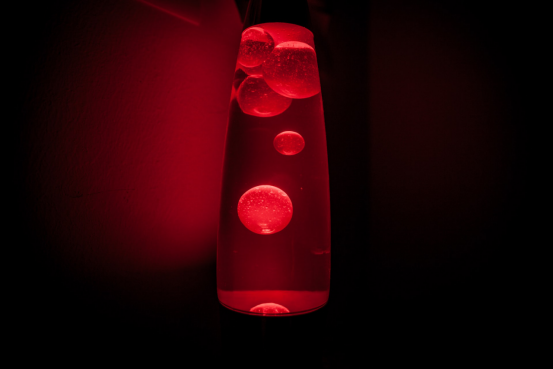
The most dramatic change. Without significant buoyancy, the heated wax would not “rise.” Instead, as the wax melted, surface tension would likely pull it into one or several large, quivering spheres suspended within the liquid. These spheres might drift slowly due to minor currents, but they would not embark on the deliberate, repeating up-and-down journey we expect.
2. Heat Distribution Goes Haywire
On Earth, convection efficiently moves heat around the lamp. In microgravity, heat transfer relies on slower processes like conduction and radiation. The area closest to the bulb could become excessively hot, potentially overheating the wax, while the top of the lamp remains much cooler. This could lead to uneven melting and strange, stagnant temperature zones, preventing the establishment of a planet-like flow cycle.
3. A New Kind of Motion Marangoni Convection
With buoyancy convection out of the picture, a more subtle force might create movement: the Marangoni effect. This is flow driven by differences in surface tension, often caused by temperature gradients. Imagine a wax blob with a hot side and a cool side. The surface tension differs on each side, which could cause the entire blob to slowly move or rotate within its liquid sphere. The motion would be subtle, unpredictable, and utterly different from the classic lava lamp rhythm.
Practical Problems in Orbit
- It Might Not “Start”: The initial phase of breaking up the solid wax cake at the bottom relies on buoyancy-driven blobs pulling away. This process might fail entirely in microgravity.
- A Safety Concern: In a consistently hot spot, the wax or liquid could reach temperatures higher than intended, posing a risk in a closed spacecraft environment.
- It Becomes a Science Experiment, Not a Lamp: Its primary value would shift from ambiance to being a brilliant demonstration of fluid physics in microgravity for educational purposes.
Conclusion An Earthbound Phenomenon
Our thought experiment reveals a core truth: the classic lava lamp is a profoundly Earth-bound invention. Its hypnotic appeal is a direct result of our planet’s gravity. In space, it would become a different kind of fascinating—a demonstration of surface tension and capillary action—but it would lose the rhythmic, calming flow that defines it.
This makes us appreciate the clever simplicity of its design even more. It’s a perfect marriage of form and function… for our home planet.
Keep your lava lamp grounded. Enjoy its perfect, gravity-dependent flow right here on Earth.